12. Responsible Consumption and Production
Students of FMIPA UNY Use Cassava Peel to Reduce Pollution from the Leather Industry
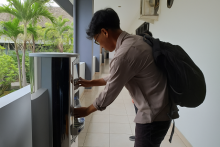
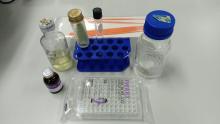
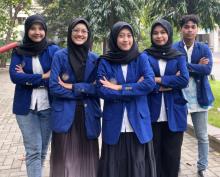
Submitted by admin on Thu, 06/26/2025 - 00:00Four students from the Faculty of Mathematics and Natural Sciences (FMIPA) at UNY have succeeded in utilizing cassava peel waste to create a magnetite-activated carbon nanoparticle composite that functions as an adsorbent for chromium (Cr) ions in the leather industry’s wastewater. The team, called “Adsorben Singkong,” consists of Ankita Cahya Muti (Chemistry, 2022), Oktavia Kusuma (Mathematics, 2022), Puput Intan Pratiwi (Mathematics Education, 2022), and Khansa Amalia Rahmah (Biology, 2023).
UNY Students Present High-Fiber Food Innovations at Culinary Innovation Festival 2025
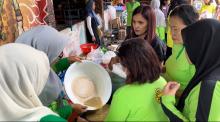
Submitted by admin on Mon, 06/23/2025 - 00:00Students of the Bachelor’s program in Culinary Education (S1 Pendidikan Tata Boga), Faculty of Engineering, UNY, once again demonstrated their creativity at the “Culinary Innovation Festival 2025”, held at Garden Level 1 of Sleman City Hall. The event, held on Saturday, 21 June 2025, carried the theme “Fiberlicious” and served as a platform for the 2022 cohort to present their high-fibre culinary product innovations created in the Product Innovation course.
Potato Peels into Eco-friendly Nanomaterials
Submitted by admin on Mon, 06/16/2025 - 14:11Universitas Negeri Yogyakarta (UNY) proudly celebrated a sustainable innovation milestone as the NanoBotato team from the Faculty of Mathematics and Natural Sciences (FMIPA) won first place at the 14th UNY Science and Engineering Fair (UNYSEF) 2025. Their project turned agricultural waste—specifically potato peels—into eco-friendly nanomaterials, addressing both waste reduction and clean water challenges in a single solution.
Orange Peel Waste into Bioadsorbent for Batik Wastewater Treatment
Submitted by admin on Thu, 06/12/2025 - 14:34A group of students from Universitas Negeri Yogyakarta (UNY) has found a creative way to help solve the problem of batik wastewater pollution by using discarded orange peels as an eco-friendly bioadsorbent. Led by Jalu Bahtiar Baharudin from the Biology program, the team extracted pectin from Citrus sinensis peels and found it to be highly effective in binding harmful dye residues typically found in batik industry waste.
Turning Waste into Opportunity: UNY Students Transform Orange Peels into Eco-Friendly Solution for Batik Waste
Submitted by admin on Wed, 05/07/2025 - 14:22UNY Appoints Environmental Monitoring Teams for First Half of 2025 to Support Sustainable Campus Development
Submitted by admin on Tue, 01/14/2025 - 15:27To strengthen its commitment to sustainability, Universitas Negeri Yogyakarta (UNY) has officially appointed dedicated teams to compile Environmental Management and Monitoring Implementation Reports for the January–June 2025 period. These teams have been assigned to oversee and document environmental practices at the Karangmalang Campus (Rector’s Decree No.
UNY Research Reveals Dual Benefits of Minapadi System: Natural Pest Control and Sustainable Fish Feed
Submitted by admin on Mon, 10/14/2024 - 09:28UNY Researchers Develop Forest-Based Livelihood Model for the Dayak Katab Kebahan Community in West Kalimantan
Submitted by admin on Wed, 10/09/2024 - 11:28A research team from Universitas Negeri Yogyakarta (UNY) has conducted an in-depth study on sustainable forest-based livelihoods among the Dayak Katab Kebahan community in West Kalimantan. Recognizing the tribe's strong customary forest management practices rooted in local wisdom, the research focused on identifying biologically rich forest resources that could economically support indigenous households while maintaining environmental sustainability.