
Student Ketoprak Festival Enlivens UNY’s 62nd Anniversary Celebration
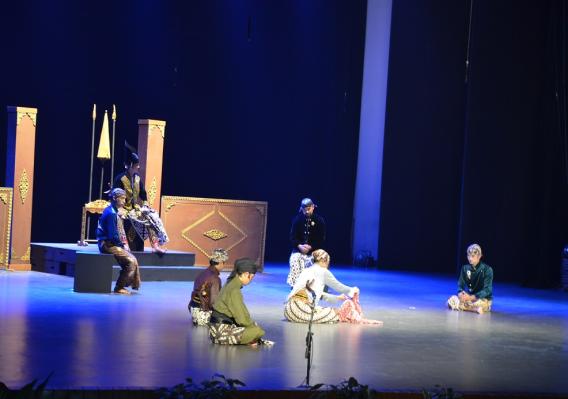
Universitas Negeri Yogyakarta held a Student Ketoprak Festival on Sunday, May 17, 2026, at the Performance Hall of the Faculty of Language, Arts, and Culture (FBSB). The cultural event, organized as part of UNY’s 62nd Anniversary (Dies Natalis) celebrations, served as an effort to preserve traditional arts while also becoming a platform for student creativity from various universities across Indonesia. The festival featured participation from five higher education institutions: Universitas Negeri Yogyakarta, Institut Seni Indonesia Surakarta, Institut Seni Indonesia Yogyakarta, Universitas Negeri Semarang, and Universitas Negeri Surabaya. Each participant presented a ketoprak performance with its own unique characteristics and creative interpretation.
According to the Rector of UNY, Prof. Sumaryanto, the atmosphere of the Student Ketoprak Festival had evolved from a regular activity into a competitive festival format, featuring various awards in line with the theme of UNY’s 62nd Anniversary: “Optimizing Achievement to Create an Impactful UNY.” The event was officially opened by the Rector through the symbolic striking of the keprak (traditional wooden percussion instrument), marking the beginning of the festival.
UNY’s representative performance was staged by students involved in UKM KAMASETRA UNY, presenting a play titled “Kembang Alang-Alang.” The performance portrayed historical events and political strategies during the Mataram Kingdom, involving figures such as Panembahan Senopati, Ki Ageng Mangir Wanabaya, and Gusti Putri Pembayun.
The story of “Kembang Alang-Alang” narrates the ambition of Panembahan Senopati to unite the land of Java under the rule of Mataram, which faced resistance from Ki Ageng Mangir Wanabaya, the powerful leader of Bumi Perdikan Mangir, who refused to submit to any kingdom. Upon the advice of Ki Juru Mertani, Panembahan Senopati refrained from launching a military attack and instead employed a subtle political strategy by sending Gusti Putri Pembayun disguised as a tayub dancer named Rante Mas to approach Ki Ageng Mangir.
The play combined political intrigue, strategies of power, sacrifice, and inner conflict, all wrapped in the richness of classical Javanese culture. At the same time, it reflected values of cultural preservation and character education aligned with the Sustainable Development Goals (SDGs), particularly SDG 4 (Quality Education) through cultural education and SDG 11 (Sustainable Cities and Communities) in preserving local cultural heritage. The UNY students’ performance successfully captured audience attention through compelling character portrayals, traditional costumes, and the use of authentic Javanese language deeply rooted in the Mataram cultural atmosphere. Audience enthusiasm remained evident throughout the performance.
The festival was judged by a panel consisting of Professor Soeminto A. Sayuti from FBSB UNY, Drs. Stevanus Prigel Siswanto, M.Hum (Dalijo Angkring), Alfianto Heriawan, Ki Murjono (the kendang player of Pangkur Jenggleng TVRI), and artist Sri Slamet Sumarwoto (Marwoto Kawer).
In the competition, Universitas Negeri Semarang won Second Honorable Mention with a score of 2100, Institut Seni Indonesia Yogyakarta earned First Honorable Mention with 2240 points, Universitas Negeri Surabaya secured Third Place with 2360 points, while Universitas Negeri Yogyakarta achieved Second Place with 2530 points. First Place was awarded to Institut Seni Indonesia Surakarta with a score of 2670.
Through the Student Ketoprak Festival, UNY hopes that younger generations will increasingly appreciate and preserve regional culture, particularly ketoprak, as a Javanese cultural heritage rich in historical and educational value.