From Waste to Value: UNY Students Transform Wood Scrap into Aesthetic Tissue Boxes
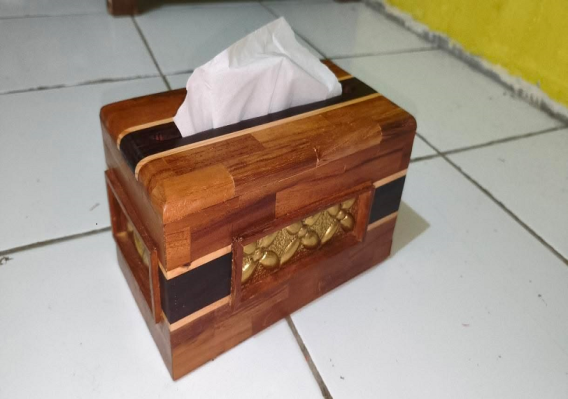
Students from Universitas Negeri Yogyakarta (UNY) participating in the Off-Campus Learning Program (PLK) have introduced a creative innovation by transforming leftover wood from student practical activities into functional and aesthetic tissue boxes at SMK Negeri 1 Kalasan, Sleman.
The initiative was carried out by students from the Craft Education Study Program, Faculty of Languages, Arts, and Culture (FBSB) UNY. The team was led by Kautsar Ahmad Raharjo, along with members Pinkan Wahyu Nafila, Alfitya Imania Rasanti, Chika Erlanika Sevianita, Calvin Alfiqri Fermansyah, and Muh. Rafi Zidan Al Rasyid.
According to Kautsar, the idea emerged from the large amount of unused wood waste generated from students’ practical sessions. “Through this activity, we aim to provide a creative solution by processing wood waste into products that are not only functional but also aesthetically valuable,” he explained.
The production process involved several stages. The wood waste was first cut into pieces measuring approximately 2 cm by 6 cm, then assembled using adhesive to form the base structure. To enhance visual appeal, different-colored wood pieces were combined in the middle section. The surface was then smoothed to ensure safety and neatness before being assembled into ready-to-use tissue boxes.
Beyond producing creative products, the activity also served as a learning medium for vocational students. It helped them develop practical skills while raising awareness about the importance of waste management and resource utilization. The involvement of UNY students also encouraged a more sustainable and creative learning environment within the school.
This collaboration highlights the role of higher education in fostering innovation and environmental awareness in vocational education. It is expected that similar initiatives can continue to be developed, providing both environmental benefits and opportunities to enhance students’ competencies in creating value-added products.
This initiative supports the Sustainable Development Goals (SDGs), particularly SDG 12 (Responsible Consumption and Production) through the reuse of wood waste into valuable products, and SDG 4 (Quality Education) by providing contextual learning experiences and strengthening students’ practical skills in vocational education.