
UNY Students Develop an Eco-Friendly Sensor to Detect Lead in Water
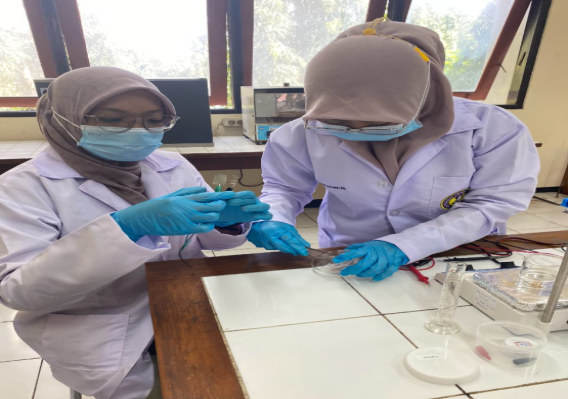
Students from the Faculty of Mathematics and Natural Sciences at Universitas Negeri Yogyakarta (UNY) have developed an environmentally friendly sensor to detect the heavy metal lead (Pb²⁺) in water, using waste banana peels as a key natural material. This innovation was created through the Student Creativity Program – Exact Research (PKM-RE) as part of efforts to address water pollution and promote sustainable science-based solutions. They are Bonita Arum Ningtyas, Devita Amalia Zuhrida, Martin Imanuel Panjaitan, Kunnasywa Sani, and Melda Novita Rahmadani.
The research team, composed of students from physics and chemistry majors, synthesized a composite material called Cu₂O/TiO₂ Nanotube Arrays (Cu₂O/TNA) using a green synthesis approach. Instead of relying on synthetic chemicals, the team used natural polyphenol compounds extracted from banana peels — a common organic waste — as reducing and stabilizing agents in the production process. This allowed the sensor to react with lead ions in water and produce a photochemical signal that enables early detection of Pb²⁺ contamination with high accuracy.
The sensor innovation is simpler, more affordable, and more eco-friendly than conventional methods that require costly reagents or complex instrumentation. By transforming biological waste into valuable detection technology, the project also supports circular economy principles and opens possibilities for broader community adoption — especially in areas where water quality monitoring is critical.