
From the Challenges of Autism to Cumlaude Graduation: The Story of Muis Dela Pondesta at UNY
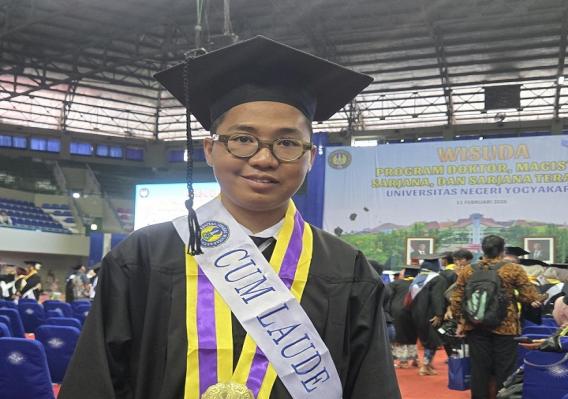
Amid the bustling atmosphere of the graduation ceremony, the story of Muis Dela Pondesta stands as a testament to the perseverance of a student who faced and overcame limitations. Muis graduated from the English Literature Study Program, Faculty of Languages, Arts, and Culture (FBSB) at Universitas Negeri Yogyakarta. He is a person with autism and bipolar disorder—hidden disabilities that often go unnoticed but present real challenges both academically and socially.
From an early age, Muis showed a strong interest in the English language. He was diagnosed with global developmental disorder and speech delay, conditions that make communication and social adaptation difficult. Despite this, the resident of Sumberadi, Mlati, Sleman, continued his education in a mainstream (non-inclusive) school and was eventually accepted to UNY through the SNMPTN (now SNBP) admissions pathway.
Upon entering university, the challenges he faced became more complex. Social interaction in crowded classrooms often triggered discomfort, causing him to leave and re-enter class to calm himself. Listening courses were particularly difficult for Muis, as they required quick auditory processing—something especially challenging for someone on the autism spectrum. “At times, I also had difficulty participating in group assignments due to limitations in social interaction, which led to retaking courses,” he said on Wednesday (Feb 25, 2026).
However, these limitations did not stop him. With open communication with lecturers and support from the campus, Muis received various academic accommodations, including extended time for assignments and exams, use of quieter study spaces, and access to counseling services. A supportive environment became key to sustaining his studies.
Beyond academics, Muis was active in contributing to FBSB’s computer lab management and involved in various social and literacy activities. He served as media division head in a faculty organization, promoted reading culture among kindergarten children in Bantul, and was trusted as a teaching assistant in children’s literature. These activities provided space for self-actualization and helped build his confidence.
For this alumnus of SMAN 1 Seyegan, graduation was not merely the end of his studies, but a symbol that disabilities—including invisible ones—do not limit someone from achieving excellence. Muis hopes his story can open broader dialogue about mental and autism disabilities in higher education and encourage the creation of a more inclusive campus ecosystem.
His family was one of the most important pillars in his journey. Emotional support, guidance, and trust from his parents helped him endure academic and social pressures. The family’s pride in Muis’s achievements strengthened his determination to continue to higher education.
At the end of his journey at UNY, Muis Dela Pondesta graduated with cum laude honors and a Cumulative GPA of 3.54, a noteworthy achievement that affirms that with support, perseverance, and an inclusive environment, students with autism can succeed with dignity. He hopes to continue his studies with a scholarship.
Muis also advised fellow people with disabilities to manage their emotions and stress, because emotional and stress management can help individuals overcome significant barriers. He encouraged all students to remember that achievement knows no limitations—even for those with disabilities—because equal rights to achievement are supported by Law Number 8 of 2016, which ensures equal opportunity for people with disabilities to succeed on the same level as others.