
Not Just Hearing — UNY Lecturer’s Research Proves Deaf Children Can Make Music
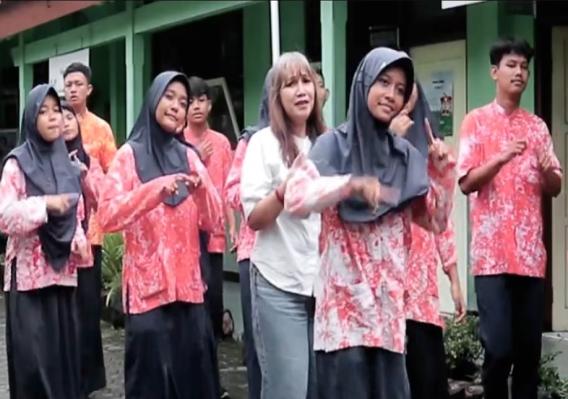
Music is often associated with sound and hearing, but that assumption has been challenged by research conducted by Dr. Drijastuti Jogjaningrum, a lecturer in Music Arts Education at the Faculty of Language, Arts, and Culture, Universitas Negeri Yogyakarta (UNY). Through her research, she has shown that deaf children can still make music using a multisensory learning approach that goes beyond auditory perception.
The research was carried out at SLB B YAKUT Purwokerto and involved 31 deaf students aged 8 to 13 years. The results showed that musicality is not solely dependent on the ears — it can also be accessed through other senses such as vision, touch, and body movement. “Music isn’t just about hearing sound. Music is a bodily experience. Deaf children can understand rhythm and tempo through vibrations, visuals, and movement,” said Dr. Drijastuti Jogjaningrum.
In the learning process, students did not listen to music in the conventional way. Instead, they were taught to feel and see music. The vibrations of an angklung instrument were used so students could feel the beat and tempo. At the same time, hand movements, color codes, visual symbols, and sign language helped them understand musical structure. This approach combined three sensory channels: tactile (feeling vibration), visual (movement and visual cues), and kinesthetic (physical movement like clapping and stepping to rhythm).
The results were significant: more than 86% of students were able to follow music lessons for 30–45 minutes with high participation. Students were also able to imitate simple rhythm patterns and respond to changes in rhythm through body movement.
In addition to improving musical ability, the multisensory approach also had positive effects on students’ social and emotional development. Children became more confident, willing to express themselves, and capable of working cooperatively in group activities. Dr. Drijastuti noted that traditional music education’s heavy focus on auditory aspects can marginalize deaf students, although their brains are capable of adapting by using other senses.
She emphasized that the multisensory method is consistent with principles of inclusive education, giving all children equal access to learning. Therefore, she encourages broader application of this method in special schools and teacher training programs. “If music learning is designed inclusively, deaf children can not only learn music but also gain space for expression, build confidence, and interact socially,” she said.
Drijastuti hopes that the results of this research will serve as a reference for educators and policymakers. According to her, music should be a universal right for all children without exception. “Deaf children can make music — they just need a different way to experience it,” she concluded.