
Biology Education Students at UNY Conduct Monitoring of Growth and Identification of Mangroves at Pasir Mendit Beach
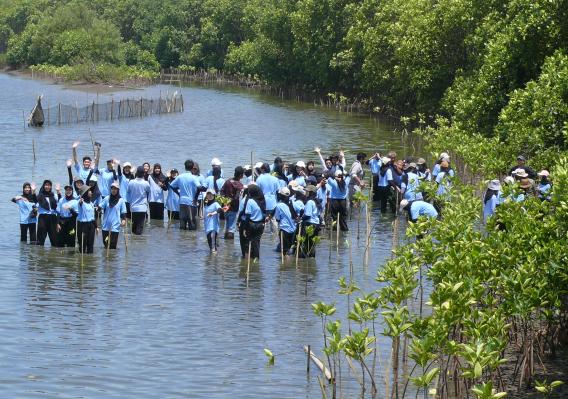
Students from the Biology Education Study Program, Faculty of Mathematics and Natural Sciences (FMIPA) at Universitas Negeri Yogyakarta (UNY) carried out activities to monitor the growth and identify mangrove species on the coast of Pasir Mendit Beach, located in Kalurahan Jangkaran, Temon District, Kulon Progo Regency.
This activity is a follow-up to the 100 mangrove saplings planting program conducted previously in October and serves as a field learning experience for students to directly observe mangrove diversity.
The monitoring was attended by five representatives of Biology Education students from FMIPA UNY, accompanied by the lecturer responsible for the Aquatic Biology course. The lecturer actively participated in observing and evaluating the growth of mangroves that had been planted. Monitoring activities included measuring trunk height, leaf size, and recording the number of mangrove individuals growing — data used to assess the condition and success of mangrove ecosystem rehabilitation in the area.
In addition to monitoring growth, students learned about identifying mangrove species found at Pasir Mendit Beach. Learning species identification is an important competency for Biology Education students because each type of mangrove has distinct morphological characteristics, structures, and ecological functions that differently impact coastal environments. Through this activity, students were trained to observe directly in the field to distinguish mangrove types based on visible morphological traits.
The Aquatic Biology lecturer, Rio Christy Handziko, explained that biology learning should not be limited to the classroom but also strengthened through field activities. He emphasized that the mangrove ecosystem is a key part of aquatic biology studies, especially in coastal areas. “Through the activity of identifying mangrove species and monitoring their growth after planting, students not only learn morphological traits from references but also conduct direct identification in nature,” he said.
Mangrove ecosystems play a strategic role in stabilizing coastal areas. They function as natural barriers against abrasion and tidal waves, and serve as habitats, shelters, and spawning areas for various aquatic organisms such as fish, shrimp, crabs, and others. With this monitoring, students are expected to better understand the condition and dynamics of mangrove growth as part of environmental preservation efforts, while strengthening knowledge of mangrove biodiversity through hands-on field experience.
This field monitoring and learning activity aligns with the Sustainable Development Goals (SDGs), especially SDG 14 (Life Below Water), SDG 4 (Quality Education), and SDG 13 (Climate Action).