UNY Biology Education Students Deliver Learning Media to Four Partner Schools
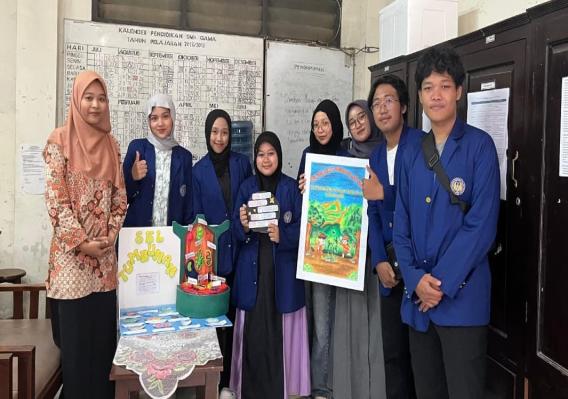
Students from the Biology Education Study Program at the Faculty of Mathematics and Natural Sciences (FMIPA), Universitas Negeri Yogyakarta (UNY) handed over biology learning media to four partner schools: SMAN 1 Seyegan, SMAN 1 Pengasih, SMA Gama, and Pondok Pesantren Ibnul Qoyyim Putri. This activity was part of the implementation of the Biology Learning Media course project and represents UNY’s contribution to improving the quality of learning in schools.
The handover marked the final stage of a series of lectures focusing on the development of innovative, contextual, and student-needs-based learning media. Through this activity, students not only enhanced their creativity but also applied pedagogical competencies and research and development skills gained during the course.
The learning media delivered included a respiratory system monopoly game, a diorama showing the movement of water in relation to pollution, and ecosystem infographics. These resources were designed to help students understand biological concepts more concretely and easily.
The media were also developed to align with specific learning models, such as Investigative Learning used in the respiratory monopoly game—encouraging systematic inquiry—and Project-Based Learning (PjBL) used in the diorama and infographics—emphasizing problem-solving relevant to real-world contexts.
Rio C. Handziko, the lecturer in charge of the Biology Learning Media course, explained that the development process followed a structured approach oriented toward quality. Before being handed over to schools, the learning media were validated by expert lecturers to ensure content accuracy and alignment with learning standards.
In addition, the validated media were submitted for Intellectual Property Rights (HKI) as legal protection for student work. Afterward, they were exhibited at the Biology Education Learning Media Laboratory before being officially delivered to teachers and school representatives to strengthen collaboration between UNY and the partner schools.
During the handover, the students explained how to use the media and discussed its potential integration into classroom activities. The biology teachers who received the materials expressed appreciation, noting that the media will significantly support teaching and learning processes.
This initiative aligns with Sustainable Development Goal 4 (Quality Education), highlighting the importance of innovation in teaching and fostering collaboration between universities and schools.