
UNY 2025 KKN-M Kependidikan Team 23928 Conducts Vermicomposting Training and Tree Planting in Singgelo Hamlet
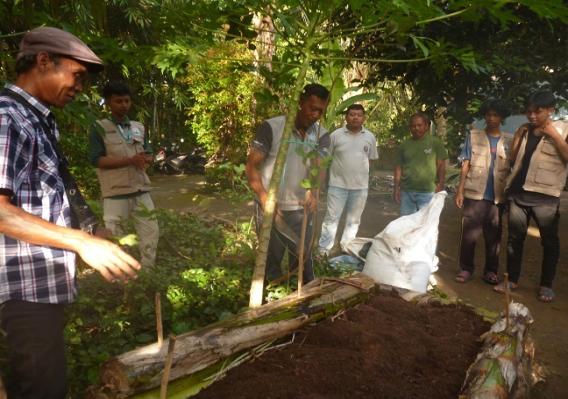
The UNY 2025 KKN-M Kependidikan Team 23928 organized a vermicomposting training program in Singgelo Hamlet, Poncosari Village, Srandakan Sub-district, Bantul Regency, Special Region of Yogyakarta. The activity featured Sujoko Slamet, an expert in organic agriculture and integrated farming, who shared insights on waste management strategies while improving soil fertility.
The training was attended by members of the Farmer Group and the Subur Sari Women Farmers Group (KWT). This program was initiated as a solution to household organic waste management issues that remain a challenge in the local community. Through vermicomposting, organic kitchen waste can be processed into kascing—solid fertilizer produced from earthworm metabolism—which helps improve soil structure and enhance agricultural productivity.
Vermicompost production utilizes African Nightcrawler (ANC) earthworms. The process begins by digging a trench 20–30 cm deep and 1–1.5 meters long, bordered with banana stems. The base layer consists of leaves, animal manure, and organic kitchen waste, followed by the addition of earthworms on top. When worms move downward, it indicates that the medium is suitable. The cultivation area must be shaded to maintain a stable temperature.
The worms are fed with kitchen waste or animal manure in quantities equivalent to their body weight. For example, 5 kg of worms require 5 kg of feed per day. The worms can be relocated for breeding purposes once they reach three months of age.
The community responded positively to the training. In addition to providing a small-scale household waste management solution, the program has the potential to create economic opportunities for the Subur Sari Women Farmers Group through the sale of earthworms and kascing as value-added products.
The KKN supervising lecturer, Dr. B. Yuniar Diyanti, expressed her appreciation for the students’ initiative in integrating environmental education with community empowerment. “Through this program, students are not only transferring knowledge but also encouraging residents to actively participate in organic waste management that is simple, affordable, and sustainable. Hopefully, the skills gained can be continuously developed into a collective movement at the hamlet level,” she stated.
Following the training, the activities continued with the planting of soursop and cashew trees. The KKN team collaborated with the Bantul Regency Environmental Agency, which provided the tree seedlings. Prior to planting, a symbolic handover of seedlings was conducted by the KKN Team Leader, Ahmad, to the Head of Singgelo Hamlet, Rizki. The trees were planted on village-owned land and fertilized with kascing to enhance soil fertility.
This vermicomposting training and tree planting program is expected to help the community address organic waste problems, improve agricultural quality, and preserve environmental sustainability for a greener future.