
UNY KKNM-26381 Students Develop “Tilapia Fish Noodles” in Simping Hamlet, Godean — Introducing a Nutrition Innovation and New Economic Opportunity
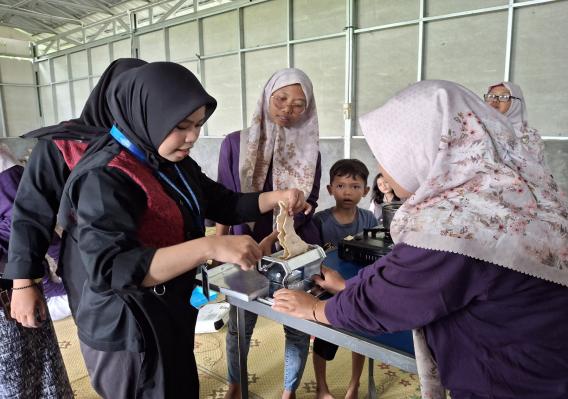
A group of KKNM-26381 students from Universitas Negeri Yogyakarta (UNY), assigned in Dusun Simping, Sidomoyo, Godean, Sleman, successfully introduced a high-nutrient local food innovation: tilapia (nila) fish noodles.
This program is one of the KKN flagship projects because it integrates nutrition education, diversification of fish-based processed foods, and community economic empowerment.
The KKNM-26381 team consists of ten students: Afifaliya Putri, Raphael Paskhalis Tarigan, Anastasia Ariyani, Anastasia Imelda Bonita Dora, Adib Fikri Ghozali, Rais Arsa Winata, Kamajaya Bayu Jatikusumo, Margareta Okta Prasetya, Shinta Faradina Shelmi, and Harti Delvia.
They conducted practical training sessions on how to make the tilapia-fish noodle together with the local women of Simping, who showed great enthusiasm throughout the process.
Afifaliya Putri, as the resource person, explained that tilapia was chosen because it is easily available in the local community and has a high protein content, making it a nutritious alternative without drastically changing residents’ eating habits. “This noodle becomes a healthy alternative to regular noodles because it is based on fish. We want the community to eat more nutritiously without leaving familiar foods,” she said.
The recipe for the tilapia-fish noodles is relatively simple and can be made at home.
The formulation includes: 155 g of high-protein flour, 100 g of tilapia meat, salt, lime juice, and appropriate amount of tapioca flour
The process involves filleting the tilapia, marinating it with lime juice, then grinding it finely. The fish flesh is mixed with the flour and kneaded until smooth, rolled using a noodle-making machine, cut into strips, and then boiled for approximately 3–5 minutes until cooked.
The training also includes techniques for storage and maintaining the noodles’ texture, so they do not become sticky easily and have a sufficient shelf life.
Harti Delvia, another student in the Food Culinary Education program, added that this innovation also serves as a strategy for introducing fish consumption in a more child-friendly way. “Not all children like to eat fish because of its shape or smell. When processed into noodles, they become more interested. So, this is not just about cooking, but also about nutrition education,” she explained.
The head of the KKNM-26381 group, Kamajaya Bayu Jatikusumo, emphasized that the tilapia noodle program was designed with sustainability in mind. The team did not only teach production, but also provided guidance on business potential: they gave simple packaging designs and marketing strategies, including using social media. “We want the residents not only to be able to make the noodles, but also to sell them. KKN is not just a temporary service, but a long-term effort to empower the community based on local potential,” he said.
The program was well received by the community, particularly among the PKK (women’s group) mothers, who appreciated getting a healthy, affordable recipe that could also become a side business.
Through this local food innovation, KKNM-26381 UNY demonstrates that students can serve as a bridge between scientific knowledge and community economic independence. Dusun Simping is not just a site of service, but a collaborative space to build food security, family nutrition, and local entrepreneurship.