
Students at UNY Develop AR Flash Cards Based on the Nyabuk Gunung Tradition for Disaster-Mitigation Education
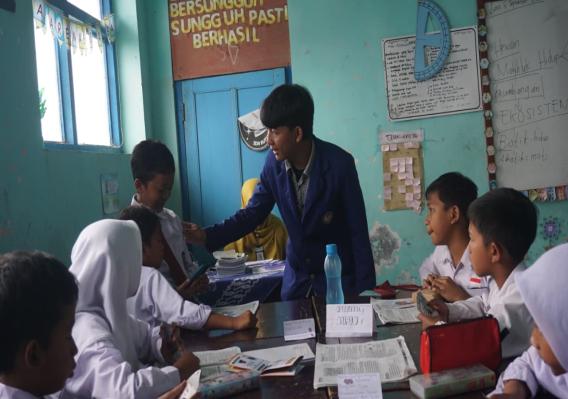
A team of students at Universitas Negeri Yogyakarta (UNY) have successfully initiated an educational innovation in the form of augmented-reality (AR) flash cards based on the tradition of Nyabuk Gunung to enhance children’s understanding of landslide-disaster mitigation. This innovation is the result of a research scheme under the Student Creativity Programme for Social-Humanities Research (PKM-RSH) funded by the Directorate of Learning and Student Affairs (Belmawa) of the Ministry of Education, Culture, Research and Technology.
The team, led by Rahmat Joan Pratama (Indonesian Language and Literature Education), includes Careva Jhilly Kanahaya S. (Civic Education / Pancasila & Citizenship), Bagus Hermawan (Indonesian Literature), Resti Aryani Widyaingsih (Psychology), and Isnaini Putri Ayu Sulistiyowati (Educational Technology).
These five students, coming from cross-disciplinary fields, worked under the supervision of a lecturer from the Faculty of Economics and Business at UNY, with the goal of creating an innovative learning medium that blends local wisdom with modern technology.
The research was motivated by the high risk of landslides in Magelang Regency, surrounded by Mounts Merapi, Merbabu, Sumbing, and the Menoreh mountain range. According to statistics from the Central Bureau of Statistics, landslide disasters were reported in 63 villages in Magelang Regency, making it an area with high landslide-frequency in Central Java. This condition necessitates early educational efforts, especially for children as a vulnerable disaster-group.
Through the development of the AR flash cards, the UNY team seeks to present learning that is attractive and interactive. Children can learn the causes, impacts, and mitigation steps for landslides via cards that present 3D visuals, text, audio, and video. Not only that, the media also carries the values of the Nyabuk Gunung local wisdom—the tradition of the community on the slopes of Sindoro-Sumbing in managing steep land wisely to prevent erosion and landslides.
“With the combination of local tradition and AR technology, we want to show that disaster mitigation can be learned in a fun way while building cultural consciousness,” said Rahmat Joan Pratama, the project leader.
The research process was carried out in three elementary schools in Magelang Regency: SD Muhammadiyah Integratif Dukun, SD Negeri 1 Payaman, and SD Negeri Grabag. Activities included needs-analysis, storyboard design, prototype development using Unity 3D, and field effectiveness testing. Data analysis used mixed-methods via pre-test and post-test as well as expert validation.
This educational media is expected to help children understand environmental risks while simultaneously loving local wisdom. In addition to producing scientific outputs such as articles and final reports, the team will also publish the results via social media so that it can be accessed by the broader public.
This innovation aligns with the Sustainable Development Goals (SDGs) Goal 4: Quality Education and Goal 13: Climate Action. Through this approach, UNY students demonstrate a real commitment to strengthening disaster-literacy and preserving local culture based on educational technology.
With a collaborative cross-field spirit, this work becomes an example of how young generation can combine tradition and innovation to build a disaster-resilient society.