
UNY Collaborates with the Umbulharjo Subdistrict and Waste Bank Forum to Hold Eco Enzyme Training
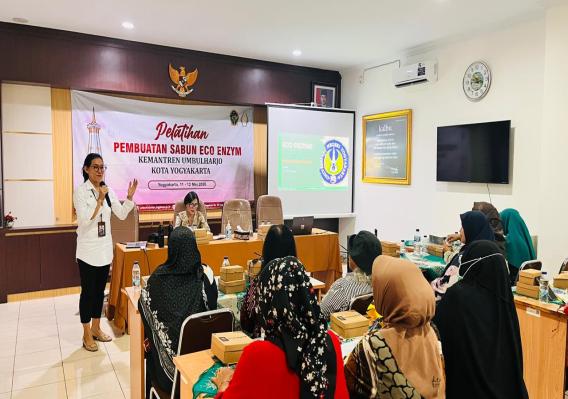
Universitas Negeri Yogyakarta (UNY) collaborated with the Umbulharjo Subdistrict Administration and the Umbulharjo Waste Bank Forum to organize an Eco Enzyme Soap-Making Training at the Umbulharjo Subdistrict Office. This activity represents one of UNY’s contributions to addressing organic waste issues in Yogyakarta through public education and community empowerment.
The training began with participant registration, an opening ceremony, the singing of the Indonesian national anthem Indonesia Raya, and remarks from the Chief Administrative Officer (Mantri Pamong Praja) of Umbulharjo Subdistrict. Participants then received introductory material on eco enzymes, including their definition, benefits for the environment and households, and their role in helping reduce organic waste.
In the next session, Isti Yunita, a Chemistry lecturer at the Faculty of Mathematics and Natural Sciences (FMIPA) UNY, delivered material on the eco enzyme production process. The session covered the introduction of ingredients and equipment, composition ratios, fermentation processes, and various tips to ensure successful eco enzyme production. Through this session, participants were expected to understand the stages of processing organic waste into more useful and value-added products.
This activity also strengthened synergy among higher education institutions, local government, and waste management communities. The collaboration between UNY, the Umbulharjo Subdistrict Administration, and the Umbulharjo Waste Bank Forum represents a concrete step toward building public awareness of waste management starting from the source.
The training aligns with the Sustainable Development Goals (SDGs), particularly SDG 4 (Quality Education), SDG 11 (Sustainable Cities and Communities), SDG 12 (Responsible Consumption and Production), SDG 13 (Climate Action), and SDG 17 (Partnerships for the Goals).
Through this training, UNY serves not only as an educational institution but also as a community partner in providing practical solutions to environmental issues. Eco enzymes are expected to become a simple alternative that can be implemented at the household level to reduce organic waste while supporting a cleaner and more sustainable Yogyakarta environment.