
History Education Students of FISIP UNY Hold Mangrove Planting and Beach Cleanup Action at Baros Beach to Support SDGs
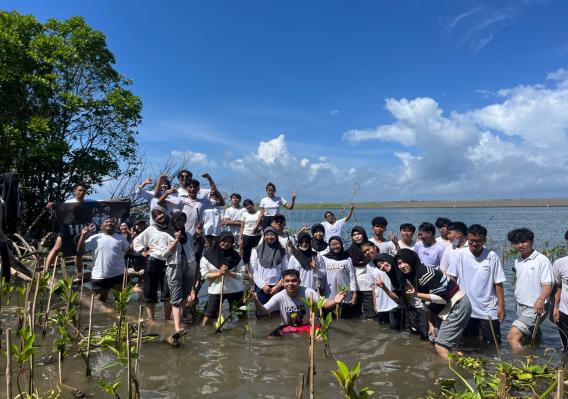
Recently, students from the History Education Program of the Faculty of Social and Political Sciences (FISIP), Universitas Negeri Yogyakarta (UNY), carried out an activity titled “Baros Beach Green Action: Mangrove Planting and Beach Cleanup” as a form of support for the achievement of the Sustainable Development Goals (SDGs). The activity took place at the Baros Mangrove Conservation Area, Baros Beach, Bantul, focusing on coastal environmental preservation through mangrove planting and beach cleanup efforts.
The activity was organized by History Education students of FISIP UNY under the supervision of Dr. Riko Septiantoko, M.Pd., with Rizky Ananda Putra serving as the chief organizer. This initiative represented a tangible expression of students’ concern for environmental issues, particularly in coastal areas vulnerable to abrasion, waste pollution, and ecosystem degradation. As one of the coastal regions in Bantul, Baros Beach plays an important role for both the environment and the surrounding community. However, waste accumulation along the shoreline and the need for mangrove conservation remain pressing concerns that require collective action. Therefore, the students chose mangrove planting and beach cleanup activities as concrete steps to maintain the sustainability of the coastal ecosystem.
This activity aligns with several SDGs, particularly SDG 13: Climate Action and SDG 14: Life Below Water. Mangrove planting was conducted as an effort to mitigate the impacts of climate change, as mangroves are capable of absorbing carbon and preventing coastal abrasion. In addition, the beach cleanup and mangrove conservation activities aimed to preserve marine ecosystems and protect habitats for living organisms in coastal areas to ensure their sustainability. Indirectly, the activity also relates to SDG 15: Life on Land, as it supports the preservation of green areas within coastal environments.
During its implementation, students carried out several stages of activity, beginning with site observation, coordination with the supervising lecturer, committee formation, preparation of equipment and materials, and culminating in mangrove planting and beach cleanup. The equipment used included mangrove seedlings, gloves, garbage bags, and other cleaning tools.
The chief organizer, Rizky Ananda Putra, stated that the activity aimed to raise awareness among students and the community about the importance of environmental conservation. According to him, simple actions such as planting mangroves and cleaning beaches can generate positive impacts when carried out consistently and sustainably.
The supervising lecturer, Dr. Riko Septiantoko, M.Pd., also supported the activity as part of contextual learning. Through field-based activities, students not only gained a theoretical understanding of environmental issues but also became directly involved in meaningful actions that benefit both society and the natural environment.
In addition to providing environmental benefits, the activity also helped students develop teamwork, leadership, social responsibility, and problem-solving skills in the field. Students also documented the activity as part of an environmental campaign and for the preparation of SDGs-related news coverage.
The expected outcomes of this activity include increased awareness among students and the community regarding the importance of maintaining beach cleanliness and conserving mangroves. The evaluation of the activity can be measured through the number of participants involved, the number of mangrove seedlings planted, the amount of waste successfully collected, and activity documentation that can be utilized as educational material.
In the future, this initiative is expected not to end as a one-time action but to continue through collaboration with environmental communities, the management of Baros Beach, local government, and student organizations. In this way, History Education students of FISIP UNY can continue to play a role as agents of change in creating a clean, sustainable, and environmentally preserved coastal ecosystem.